Mechanical and SolidWorks Services / Technical Production

Bill of Materials Preparation Services for Traceable Product Data

A bill of materials is often treated as a drawing table. In practice, it connects engineering, purchasing, fabrication, assembly and product support. When identifiers, quantities or material references disagree, incorrect items may be ordered and revision questions become difficult to trace.

CAD Conversion Services India provides bill of materials preparation services for manufacturers, equipment builders, engineering companies and fabrication teams. We develop structured parts information from client-approved SolidWorks models, drawings, specifications and legacy records. The work can cover a single assembly, a multilevel product structure or a recurring flow of drawing BOM updates.

Our offshore team organises and checks supplied information without becoming the product authority. The client confirms part selection, approved materials, make-or-buy status, procurement rules, substitutions and release. AI-assisted tools may help compare lists, identify repeated descriptions or classify source files, but an expert reviewer evaluates the results before delivery.

For companies looking to outsource bill of materials preparation, the objective is clear: create dependable product data that can move through the next business process with fewer preventable inconsistencies.

✓ AI Powered✓ Free Pilot Batch✓ NDA Protected✓ 99.5% Quality
Warehouse specialist checking organised component inventory in labelled storage bins with a clipboard
Controlled component inventory
1500+Completed Projects
82%Returning Clients
10+Years Experience
45+Countries Served
35+Professionals Team

Project Fit at a Glance

Confirm these essentials before production begins.

Inputs

Sketches, legacy drawings, samples, measurements and approved engineering instructions

Outputs & deliverables

Parts, assemblies, production drawings, BOMs and agreed exchange files

Software

SolidWorks, AutoCAD and agreed mechanical CAD formats

Service intent

Focused production support for Bill of Materials Preparation, with scope, source authority and review responsibility agreed before work begins.

IndustriesArchitectureConstructionManufacturingEngineeringReal EstateCountries ServedUSACanadaUKAustraliaUAEEuropean Nations45+ Countries

Why BOM Quality Matters Beyond the Drawing Sheet

Different departments use a parts list differently. Engineering needs traceable relationships, purchasing needs approved identifiers and quantities, and production needs a clear assembly breakdown. A useful BOM serves those needs while remaining connected to a controlled product structure.

Common problems include:

  • Duplicate part numbers assigned to different components
  • Identical components described in inconsistent ways
  • Quantities that do not reflect the selected assembly configuration
  • Drawing balloons that do not match the parts list
  • Material or profile fields populated differently across projects
  • Purchased items mixed with fabricated items without classification
  • Obsolete components remaining in copied BOM tables
  • Flat lists used where a parent-and-child structure is required
  • Manual tables disconnected from the latest SolidWorks assembly
  • Revision identifiers that do not agree across drawings and schedules

Our role is to expose and organise these issues. We do not decide which disputed record is correct unless the client provides an authoritative instruction.

BOM Formats We Can Prepare

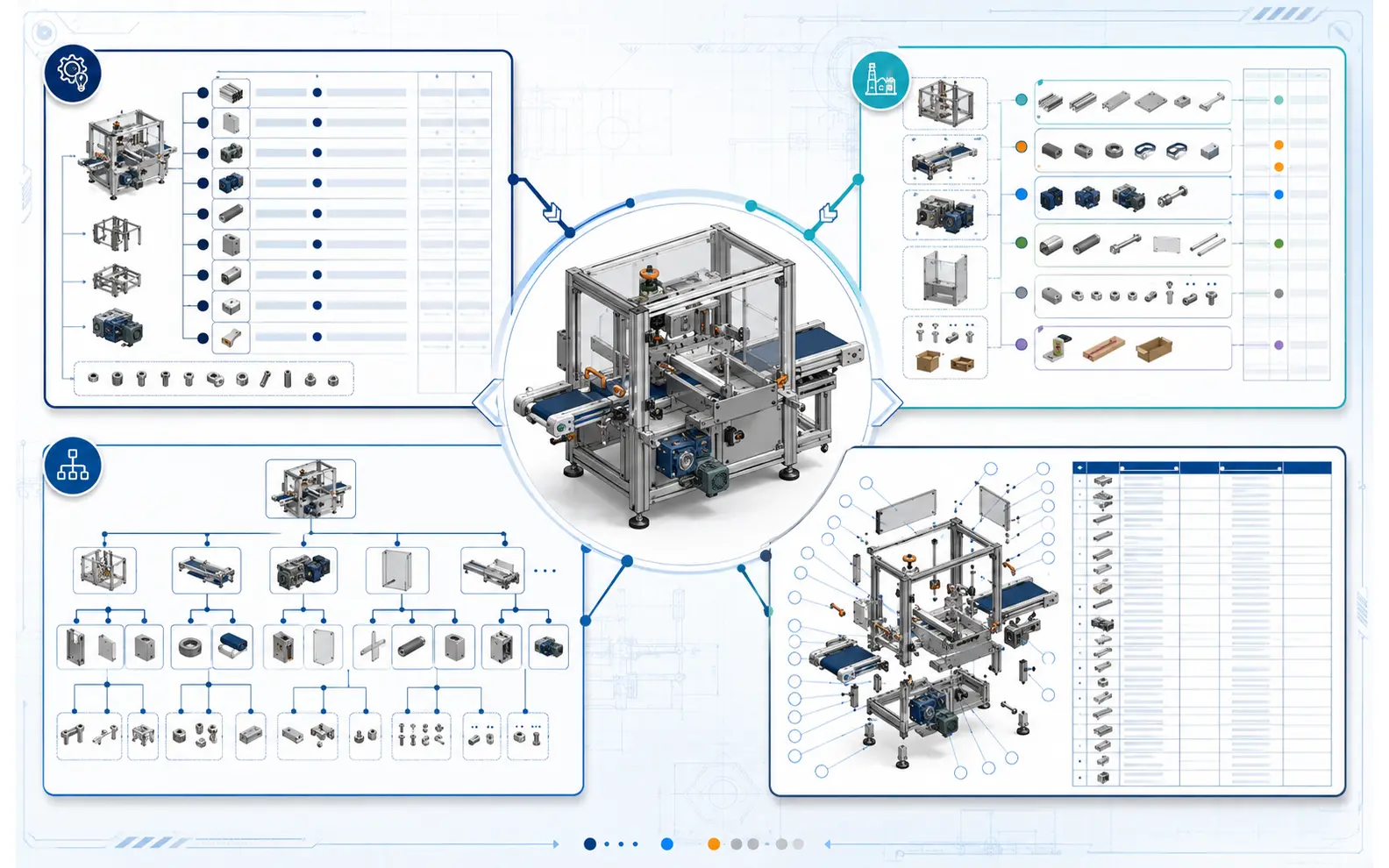
Comparison of engineering, manufacturing, multilevel and drawing BOM structures connected to the same packaging-machine assembly
Engineering, manufacturing, multilevel and drawing BOMs organise the same approved product differently according to their defined downstream purpose.

Engineering BOM Creation

Engineering BOM creation reflects the product as defined by the approved design structure. It can show top-level assemblies, subassemblies, fabricated parts, purchased components and relevant reference items. The hierarchy is established from the supplied models and client rules rather than inferred from appearance alone.

An engineering BOM may include part number, revision, description, quantity, material, mass, finish, drawing reference or other approved attributes. Required fields vary significantly by organisation, so we map them before production begins.

Manufacturing Bill of Materials

A manufacturing bill of materials may group information according to how a product is fabricated or assembled rather than exactly how the engineering model is organised. Assembly BOM preparation can therefore require an approved transformation between design structure and production structure.

We can document that transformation when the client defines the grouping, phantom assemblies, kits, consumables and process-specific items. Decisions about manufacturing sequence, stock policy and production planning remain with the client.

Multilevel and Indented Structures

Multilevel BOM creation shows the relationship between parent assemblies and their children. Indentation, level numbering or structured identifiers help users understand where each item belongs. This approach suits machinery, equipment skids, modular products and other assemblies containing several layers.

We check that the hierarchy does not create unintended loops or orphaned components. Where the same part appears in several branches, its usage can be reported according to the required roll-up or occurrence rule.

Drawing and Fabrication Lists

SolidWorks BOM tables can be placed on assembly drawings and linked to model properties. We also prepare fabrication parts lists, cut-item schedules and quantity and material schedules from approved information. Balloon numbering and table ordering can follow the client’s drawing standard.

The final format may be a native SolidWorks table, an Excel workbook, a CAD schedule, CSV data or a client template. Product structure documentation can also include mapping notes or exception registers when the source data needs clarification.

Information Sources and Their Limitations

Native assemblies provide relationships and occurrences, but their properties may be incomplete. Drawings can contain approved notes missing from the model, while ERP exports may use an older revision. Legacy spreadsheets may lack a clear hierarchy.

We establish the authority of each source at the start. Typical inputs include:

  • SolidWorks parts, assemblies and drawings
  • Existing SolidWorks BOM tables
  • AutoCAD or PDF assembly drawings
  • Engineering spreadsheets and master parts lists
  • ERP, MRP or PLM exports supplied by the client
  • Fabrication drawings and approved material schedules
  • Redline mark-ups and engineering change notices
  • Product catalogs and controlled component specifications

When sources disagree, we record the affected item, the competing values and the documents reviewed. This query-led method is safer than silently selecting the most convenient entry.

A Controlled Path from Components to Released Data

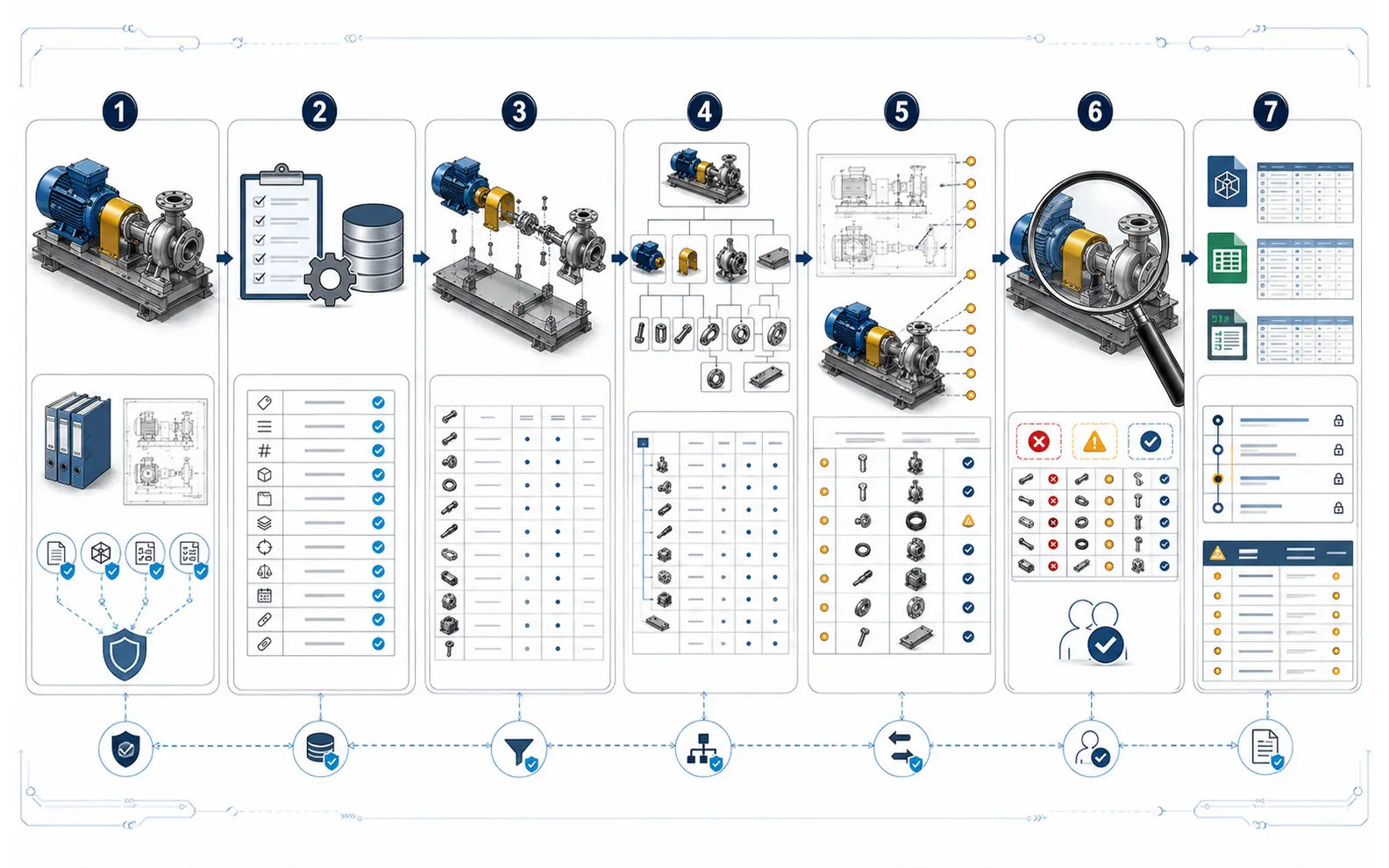
Seven-stage BOM workflow covering purpose definition, data rules, extraction, hierarchy building, model reconciliation, human review and controlled delivery
Purpose, field rules, approved properties, hierarchy, drawing reconciliation, professional review and recorded exceptions remain traceable through BOM delivery.

1. Define the BOM Purpose

We confirm whether the deliverable is an engineering structure, manufacturing list, drawing table, purchasing schedule or service-oriented parts list. The intended use determines the hierarchy, required columns, quantity logic and output format.

2. Establish Data Rules

Part-number syntax, description format, unit of measure, material naming, revision display, purchased-versus-fabricated classification and configuration logic are documented. Client templates and examples provide the preferred baseline.

3. Extract and Normalise

Approved fields are collected from the supplied sources. BOM data cleanup may include trimming unwanted spaces, applying controlled capitalisation, separating combined fields, standardising approved abbreviations and aligning repeated descriptions. AI may assist with pattern detection, but changes are reviewed by a person.

4. Build the Required Structure

Components are placed into the approved flat or multilevel relationship. Quantities are calculated from the selected configuration or entered from authorised instructions. We distinguish per-assembly quantities from total rolled-up quantities where both are required.

5. Reconcile Drawings and Models

Parts list development is checked against visible components, balloons, referenced drawings and model occurrences. Suppressed, envelope, reference or excluded components are handled according to the client’s defined rule.

6. Conduct a Professional Review

The reviewer checks completeness, duplicate identifiers, missing properties, inconsistent quantities, hierarchy gaps, revision fields and table presentation. Questions requiring engineering or commercial judgement are returned to the appointed client contact.

7. Deliver and Record Exceptions

Final files are submitted with any agreed exception register. Native and exchange formats are organised by revision so the client can review and approve the package before using it for procurement, fabrication or assembly.

What Our BOM Checks Can—and Cannot—Confirm

Our checks focus on the internal consistency of the supplied product information. Depending on scope, they may cover:

  • Presence of mandatory fields
  • Duplicate or missing part identifiers
  • Quantity agreement between model occurrences and tables
  • Parent-child relationships in multilevel structures
  • Balloon-to-table correspondence
  • Material and description formatting against approved rules
  • Drawing BOM updates after an accepted model revision
  • Configuration-specific inclusion or exclusion
  • Revision and file-name consistency
  • Completeness of requested output formats

These checks do not certify that a selected material is technically suitable, a purchased component is available, a quantity is commercially optimal or a product meets performance and regulatory requirements. The client’s engineers, purchasing team and production authorities retain those responsibilities.

This distinction is central to our bill of materials preparation solution: CCSI prepares and validates documentation against approved sources, while authorised stakeholders decide what the product contains.

Engagement Options for Different Product Environments

One-Time Assembly Package

A fixed scope may cover one machine, one fabricated system or a defined product family. A sample output confirms the hierarchy, columns and table style before the full assembly is processed.

Legacy BOM Recovery

Older drawings and spreadsheets can be consolidated into a more consistent structure. We preserve traceable values, identify incomplete attributes and separate confirmed information from fields awaiting approval.

Product-Line Standardisation

Related assemblies may contain similar parts described or numbered differently. We can compare those records and prepare a normalised view for client review. Merging, renumbering or superseding components occurs only after authorised instruction.

Recurring Change Support

For companies issuing frequent engineering changes, offshore bill of materials preparation services can operate through scheduled batches. Controlled templates, revision inputs and named reviewers help keep each cycle traceable. This model supports regular drawing and schedule maintenance while the client controls product release.

Why Manufacturers Use External BOM Capacity

BOM preparation can consume significant engineering time, particularly when models contain inconsistent properties or legacy lists require reconciliation. A dedicated production resource allows internal teams to focus on design decisions, supplier questions and release management.

Our bill of materials preparation outsourcing services may support backlog clearance, new-product documentation or continuing data maintenance. CCSI acts as an expert bill of materials preparation service provider within the client’s defined system, using SolidWorks, AutoCAD and structured data tools as appropriate.

The engagement can range from a controlled pilot to outsourced bill of materials preparation support for several product lines. Professional bill of materials preparation services work best when the source revision, required fields, owner of technical queries and acceptance criteria are agreed in advance.

Bill of Materials Preparation Project Case Studies

Packaging-Line Multilevel BOM Reconstruction

Project Name
Packaging-Line Multilevel BOM Reconstruction
Volume
11 machines, 96 subassemblies and 2,840 component occurrences
Problem
A French equipment manufacturer had reliable SolidWorks geometry but inconsistent custom properties. Flat spreadsheets had been maintained separately, making it difficult to trace purchased and fabricated items to their parent assemblies.
Solution
Our offshore team mapped the approved fields, created an indented structure, reconciled drawing balloons and prepared exception records for duplicate part numbers. The client’s engineering manager decided the disputed classifications and revisions.
Outcome
The resulting BOM package gave engineering and purchasing a shared, reviewable product structure without replacing the client’s release process.
Title
Industrialisation Manager
Industry
Packaging Equipment
Country
France

Fabrication Parts List Recovery for Water-Treatment Skids

Project Name
Fabrication Parts List Recovery for Water-Treatment Skids
Volume
27 skid assemblies and 164 drawing sheets
Problem
A UAE system integrator relied on drawing tables copied across projects. Several plates and pipe supports carried outdated descriptions, while quantities differed between general assemblies and detail sheets.
Solution
The company chose to outsource the reconciliation package. We traced item marks across the approved drawings, rebuilt fabrication lists and separated unresolved material references into a query register. A professional checker verified every updated table against its source sheet.
Outcome
The client received consistent fabrication schedules for final engineering review, reducing time spent comparing disconnected tables before release.
Title
Project Engineering Lead
Industry
Water-Treatment Systems
Country
United Arab Emirates

Recurring Agricultural Equipment BOM Updates

Project Name
Recurring Agricultural Equipment BOM Updates
Volume
12–20 engineering changes per month across 7 product families
Problem
A South African machinery producer needed regular BOM maintenance after approved model changes, but internal designers were losing time updating spreadsheets and drawing tables manually.
Solution
We established a monthly change queue, linked each instruction to the affected assembly and used an expert review checklist for quantities, revisions and balloon references. Technical substitutions remained subject to client approval.
Outcome
BOM updates became a predictable release activity, and the engineering team gained more time for product decisions and production support.
Title
Engineering Operations Manager
Industry
Agricultural Machinery
Country
South Africa

Bill of Materials Preparation Client Feedback

Questions About Bill of Materials Preparation

Can you prepare a BOM from a SolidWorks assembly?

Yes. We can use the assembly hierarchy, selected configuration, component occurrences and approved custom properties to prepare the required table or structured file. Missing or inconsistent fields are reported for clarification.

Can you combine drawings, spreadsheets and ERP exports?

Yes, provided the client identifies the authority and revision of each source. We can compare and consolidate the supplied information, but disputed part numbers, materials, quantities and commercial attributes require client approval.

Do you decide which components should be purchased or fabricated?

No. We can apply an approved classification and identify inconsistencies. Make-or-buy decisions, substitutions, supplier selection, stock policy and procurement approval remain with the client.

Can we outsource regular engineering-change updates?

Yes. A recurring workflow can include model review, drawing BOM updates, controlled data cleanup and exception reporting. It should use a defined change source, revision rule and authorised approver.

Build a More Dependable Product-Information Baseline

Send us a representative assembly, existing parts list and the fields required by your engineering or manufacturing process. We will examine the source structure, identify obvious gaps and recommend a practical production workflow for accurate, reviewable BOM data.

Request a BOM Preparation Review
QuickQuote