Structural Analysis Services Support for Engineer-Led Projects
Reliable structural analysis begins with defined criteria, traceable inputs and qualified engineering judgement. Our structural analysis services support architects, structural consultancies, contractors and asset teams that need additional capacity for calculations, model preparation, load evaluation and technical documentation.
CAD Conversion Services India works within an engineer-led authority structure. Calculations are performed and reviewed by suitably qualified engineers for the agreed scope, while the appointed engineer of record or locally licensed professional retains responsibility for project criteria, code interpretation, design approval, statutory submission and any signature or seal required in the project jurisdiction.
This boundary adds offshore capacity without obscuring who makes and approves structural decisions.
✓ AI Powered✓ Free Pilot Batch✓ NDA Protected✓ 99.5% Quality
1500+Completed Projects
82%Returning Clients
10+Years Experience
45+Countries Served
35+Professionals Team
Project Fit at a Glance
Confirm these essentials before production begins.
Inputs
Engineer-issued design information, calculations, mark-ups and project standards
Outputs & deliverables
Structural models, drawings, schedules and material-specific detailing
Software
AutoCAD, Revit and agreed structural-production tools
Service intent
Focused production support for Structural Analysis Services, with scope, source authority and review responsibility agreed before work begins.
IndustriesArchitectureConstructionManufacturingEngineeringReal EstateCountries ServedUSACanadaUKAustraliaUAEEuropean Nations45+ Countries
IndustriesArchitectureConstructionManufacturingEngineeringReal EstateCountries ServedUSACanadaUKAustraliaUAEEuropean Nations45+ Countries
Analysis Support Built Around the Project’s Design Basis
A numerical model is only as reliable as the assumptions behind it. Before analysis begins, we establish which documents are authoritative and which decisions have already been approved. The client should provide, or nominate the responsible engineer to confirm, the relevant design basis.
Inputs commonly include:
Structural layouts, member geometry and material properties
Applicable loading criteria and combinations
Intended use, occupancy and project stage
Support, restraint and connectivity assumptions
Geotechnical information relevant to the model
Wind, seismic and environmental parameters
Governing codes and client design standards
Existing calculations and previous model files
Required outputs, calculation format and review route
When information is incomplete, we record the uncertainty and seek direction. We do not use automation to invent loads, select an unconfirmed code provision or conceal a modelling assumption.
Structural Analysis Capabilities
The service can be configured for a complete defined package or for specific tasks within a client-controlled workflow.
Building Structural Analysis
Building structural analysis may cover gravity and lateral systems, load paths, global behaviour and member response for steel, reinforced-concrete or mixed-material structures. The model purpose and required level of refinement are agreed first so analytical effort is proportionate to the decision being made.
Static Load Analysis
Static load analysis can evaluate structural response under defined permanent, imposed and equipment loads. Results may include reactions, displacements, internal forces and utilisation information, subject to the calculation method and design criteria approved for the assignment.
Steel and Concrete Structure Analysis
Steel structure analysis can support frame behaviour, bracing evaluation, member-force extraction and serviceability review. Concrete structure analysis may address frames, slabs, walls and other defined elements. Material models, cracked-section assumptions, stiffness modifiers and design checks must follow instructions from the responsible engineer.
Wind and Seismic Analysis Support
Wind load analysis and seismic analysis support require project-specific geographic, structural and code inputs. Our engineers can prepare models and calculations using confirmed criteria, document assumptions and provide outputs for the appointed engineer’s review. Local code compliance and final acceptance are not inferred from software results alone.
Finite Element Analysis Support
Finite element analysis support may be appropriate for slabs, plates, complex load distribution, local behaviour or other conditions where simplified methods are insufficient. Mesh strategy, boundary conditions, element selection and result interpretation are reviewed by an expert engineer because an attractive contour plot is not evidence of a correct model.
Load Combinations and Traceable Calculation Logic
Load combination analysis connects individual actions to the limit states or design checks required by the project basis. We can prepare or implement combinations supplied or approved by the responsible engineer and maintain clear references between load cases, combinations and reported results.
The calculation package may include:
Load-case definitions and source references
Combination tables and governing-result summaries
Model diagrams and support conditions
Reaction, force and displacement outputs
Member or element check summaries
Assumptions, exclusions and outstanding queries
Version, revision and review records
This traceability is particularly important when a client chooses to outsource structural analysis support across time zones. The reviewing engineer needs to understand not just the result, but also the criteria and model state that produced it.
Frame Analysis and Stability Assessment
Frame analysis services can support portal frames, braced structures, moment frames and other defined structural systems. Depending on the brief, the work may examine first- or second-order response, drift, deflection, member forces and sensitivity to selected assumptions.
A structural stability assessment requires careful consideration of imperfections, effective lengths, restraint, non-linear effects and the relevant design method. These inputs are never treated as generic defaults. They are established with the responsible structural engineer and documented in the calculation record.
Where the available information suggests a different behaviour from the expected load path, we stop and raise the issue. An offshore production schedule does not override the need for engineering clarification.
Human-Reviewed Analysis with Responsible AI Assistance
AI and scripted processes can help organise source data, compare calculation revisions, check model naming and identify unusual values. They may also assist with repetitive extraction of reactions or member results. Their role is administrative and diagnostic, not authoritative.
Every analytical model and calculation package remains under qualified human control. An engineer reviews the modelling approach, loading, combinations, assumptions and reported conclusions. A second professional review can be included where the agreed quality plan calls for independent checking.
AI is not permitted to approve a member size, assert compliance, select missing environmental data or replace the judgement of the appointed engineer. This distinction is central to our structural analysis support solution.
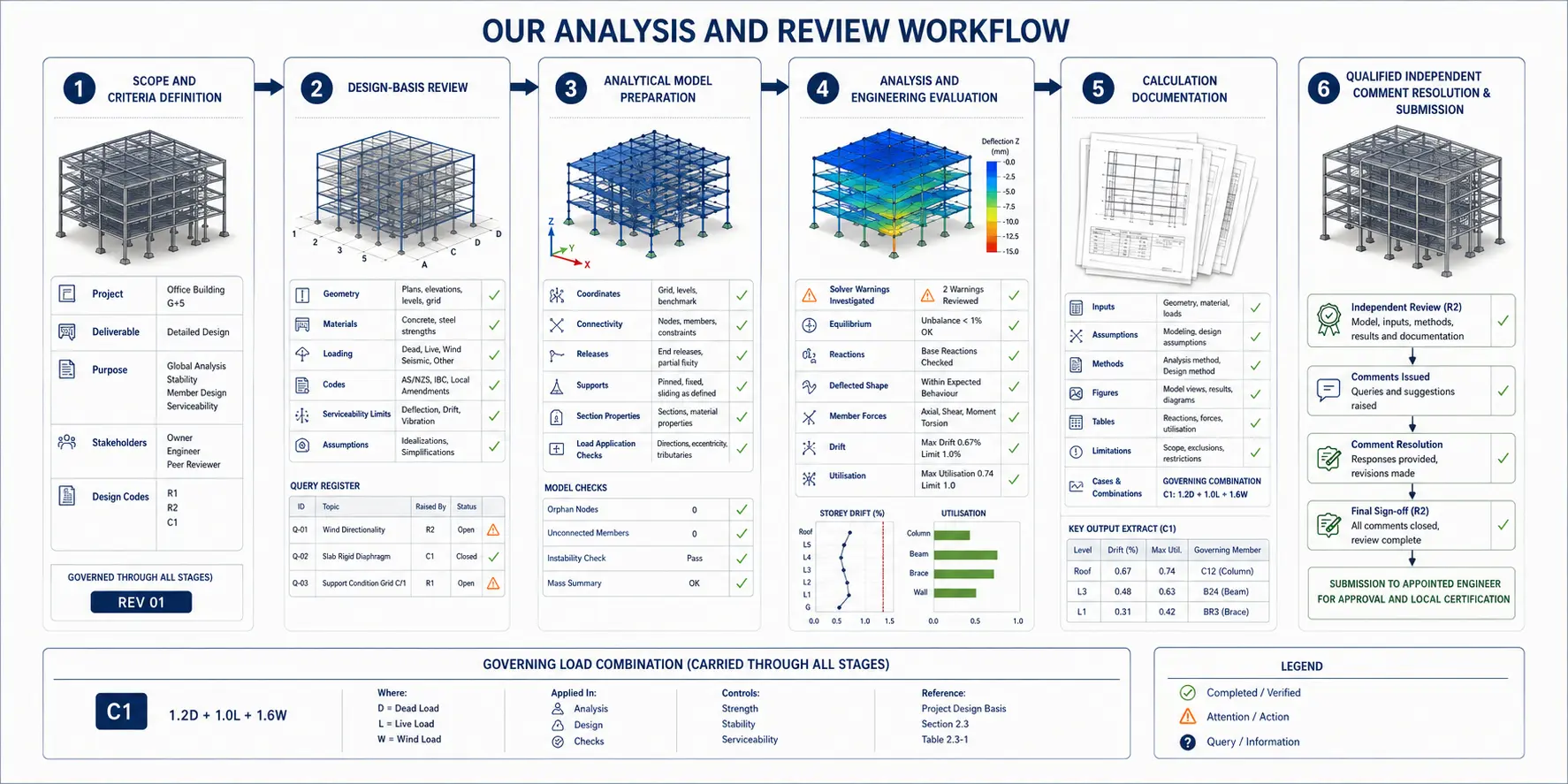
Our Analysis and Review Workflow
1. Scope and Authority Definition
We identify the structure, design stage, required calculations, governing information and responsible reviewers. The scope states which decisions belong to our qualified engineers and which require client or locally licensed approval.
2. Design-Basis Review
Geometry, materials, loading criteria, codes, serviceability limits and modelling assumptions are checked for completeness. Gaps and conflicts are placed on a query register.
3. Analytical Model Preparation
The model is created or reviewed using the agreed software and conventions. Coordinates, connectivity, releases, supports, member properties and load application are checked before solving.
4. Analysis and Engineering Evaluation
The analysis is run, warnings are investigated and results are evaluated for plausible structural behaviour. Governing forces, reactions, movements and utilisation measures are extracted as required.
5. Calculation Documentation
Inputs, assumptions, methods, figures, result tables and limitations are organised into a reviewable calculation package. Important model outputs are linked to their source cases and combinations.
6. Qualified Review and Client Approval
The assigned checker reviews the package against the agreed basis. Comments are resolved and the files are submitted to the appointed engineer for project approval, code confirmation and any required local certification.
What We Check Before Submission
Our quality review may include:
Units, coordinates, grids and model orientation
Member connectivity, end releases and offsets
Section and material assignments
Support and restraint conditions
Load direction, magnitude and distribution
Load cases and approved combinations
Solver warnings, instabilities and convergence messages
Reaction balance and overall equilibrium
Deflected shape and load-path plausibility
Result extraction and governing-case references
Calculation revisions, assumptions and exclusions
Automated comparison can help locate differences between versions, but an expert reviewer determines whether those differences are acceptable or require correction.
Offshore Capacity for Consultancies and Project Teams
Our offshore structural analysis support services are suitable when a consultancy has a defined calculation backlog, a contractor needs temporary analytical capacity, or an asset team needs existing information evaluated under an engineer-led scope.
Structural analysis support outsourcing services can be arranged for a single project phase or a recurring workstream. Inputs and results move through agreed issue registers, and technical questions are directed to named reviewers. This keeps outsourced structural analysis support connected to the client’s design-management process.
As an expert structural analysis support service provider, we do not present software operation as engineering authority. Our professional structural analysis support services are delivered by qualified personnel, with responsibility, limitations and required local approval identified in writing.
Clients seeking a structural analysis support solutions company India can therefore engage a defined technical resource while maintaining the governance expected on structural work.
Structural Analysis Services Project Case Studies
Project 1: Lateral-System Review for a Mid-Rise Office Building
Volume
12-storey reinforced-concrete frame; 3D global model and 168-page calculation package
Problem
A European structural consultancy needed additional capacity to evaluate a revised core-and-frame arrangement before its planning-stage design review. The wind criteria and serviceability limits were defined, but model assumptions from an earlier option had not been fully documented.
Solution
Qualified engineers rebuilt the model register, verified member properties and documented diaphragm, support and stiffness assumptions. Wind cases and approved combinations were applied, then storey drift, reactions and governing frame forces were extracted. A separate checker reviewed warnings, equilibrium and the calculation narrative before submission to the consultancy’s project engineer.
Outcome
The consultancy received a traceable comparison between the original and revised arrangements. Its appointed engineer used the results to select the preferred scheme and retained final responsibility for code compliance and design approval.
Title
Associate Structural Engineer
Industry
Commercial Building Design
Country
Germany
Project 2: Static and Equipment-Load Assessment for an Industrial Platform
A UAE industrial contractor needed to evaluate new equipment on an existing platform. The available drawings did not clearly distinguish original design loads from later operational additions, creating a risk of modelling an incorrect baseline.
Solution
We prepared an information-gap schedule and worked from site-verified geometry, confirmed equipment reactions and material data approved by the contractor’s engineer. The team developed a frame model, ran the authorised load combinations and reported member forces, support reactions and serviceability results. Unverified connection capacity and foundation adequacy were explicitly excluded.
Outcome
The contractor’s structural consultant received a focused calculation record for its final assessment. The report clearly separated analysed platform behaviour from connections and foundations requiring separate verification.
Title
Engineering Manager
Industry
Industrial Facilities
Country
United Arab Emirates
Project 3: Recurring Model and Calculation Support for Small Building Alterations
Volume
4–7 engineer-defined work packages per month
Problem
An Australian consultancy handled frequent beam removals, rooftop additions and equipment-support modifications. Its senior engineers were spending excessive time rebuilding simple models and formatting calculation appendices instead of reviewing the engineering decisions.
Solution
We established an ongoing workflow in which each assignment arrived with an approved design-basis sheet. Our engineers prepared the analytical model, result tables and draft calculation record, while unclear site or loading information was returned through a query log. A checking engineer reviewed each submission before the client’s locally registered engineer completed the final design review.
Outcome
The consultancy reduced preparation time while preserving its approval structure. Standardised files made senior review quicker, and incomplete briefs were identified before modelling progressed too far.
Title
Principal Engineer
Industry
Structural Engineering Consulting
Country
Australia
Structural Analysis Services Client Feedback
“
The model comparison was clearly documented, including the assumptions inherited from the earlier scheme. That made our internal engineering review much more efficient.
Lukas M., Associate Structural Engineer, Germany
“
They did not hide the limits of the available information. The platform results, exclusions and outstanding connection checks were separated exactly as our consultant required.
Omar K., Engineering Manager, United Arab Emirates
“
The recurring workflow gives our senior engineers a consistent package to review. Queries arrive early, and the calculations remain under our nominated engineer’s approval.
Sophie W., Principal Engineer, Australia
Questions About Structural Analysis Services
Are your structural calculations signed or sealed?+
Structural analysis work must have a named technical reviewer and an agreed calculation basis. If the jurisdiction requires a registered engineer’s certification, signature or seal, the client must appoint that person and define the review route before relying on the results.
Can you select the governing design code and loads?+
The governing code, jurisdictional parameters and project loading basis should be supplied or confirmed by the appointed engineer. We can help identify missing criteria and prepare calculations from the approved basis, but we do not assume unconfirmed regulatory inputs.
Can you review an existing analysis model?+
Yes. A structural calculation review can examine model geometry, properties, restraints, loads, combinations, warnings and result presentation. The scope should state whether the review is a limited technical check, an independent calculation or support for the responsible engineer’s broader design review.
Which analysis software do you use?+
Software is selected according to structural type, required method, client compatibility and deliverables. During scoping, we confirm the application and version, exchange format, calculation outputs and whether the client requires native model files.
Begin with the Design Basis, Not Just the Model File
Send us the latest structural information, required analysis, confirmed loading criteria, applicable standards and approval route. We will identify gaps, define deliverables and propose a suitable workflow.
Whether you plan to outsource one calculation package or outsource recurring offshore work, a clear authority matrix keeps the work useful and properly governed.